
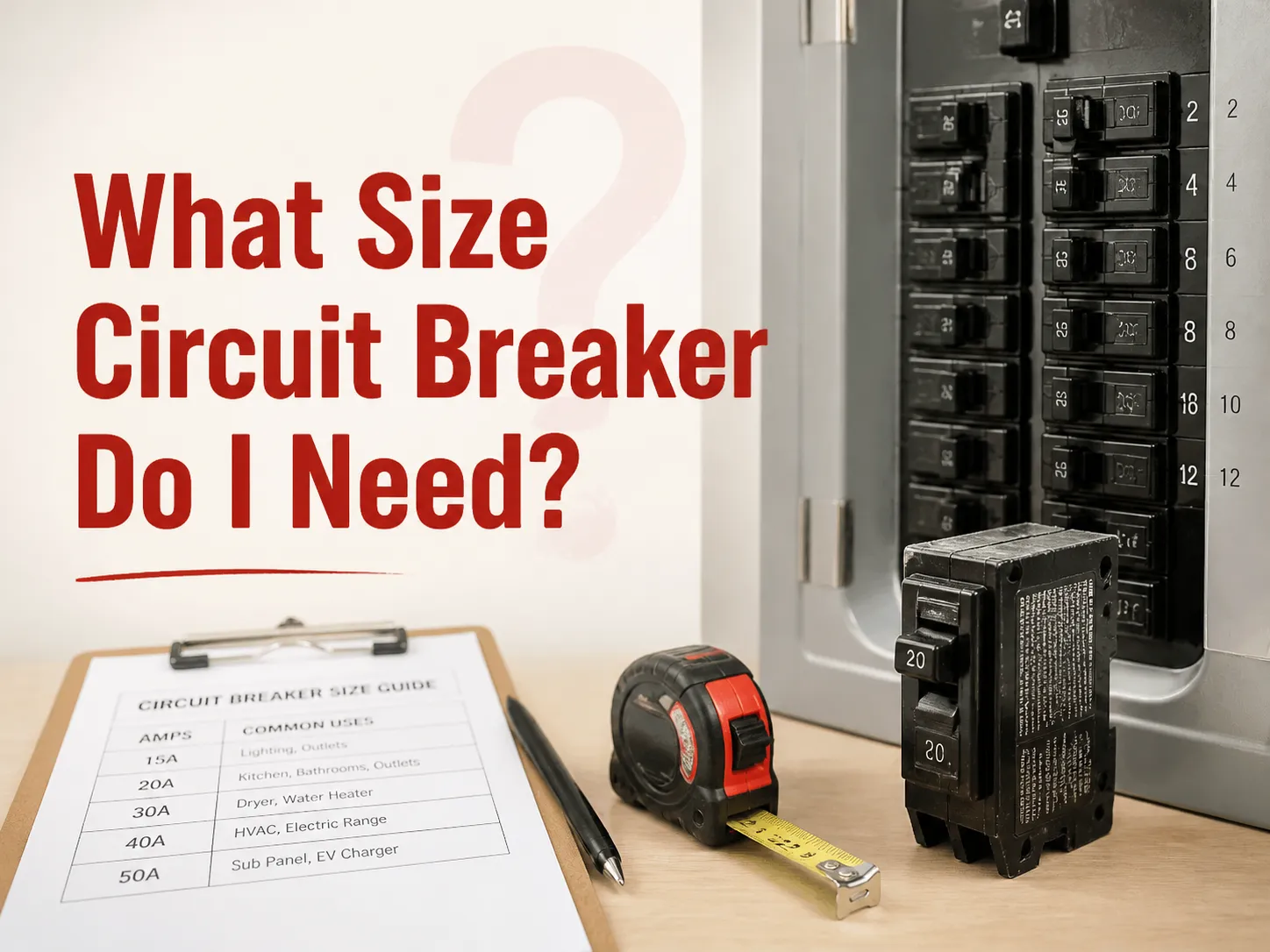
Getting the correct size circuit breaker is vital in keeping your electrical system safe and avoiding any accidents such as sparks when electricity is flowing through your appliances. If you buy an air conditioner, solar panel, or even an electric stove, it’s important you choose a breaker that can accommodate what your appliance draws from the grid (amps). This guide is designed to assist you in understanding how to calculate breaker size and which type you should buy as well as to address some of your most frequently asked questions regarding certain devices and systems.
How to Determine Circuit Breaker Size – Overview
The size of your circuit breaker, that is, the amount of energy (measured in amps) your circuit will require to protect itself, becomes quite important. The following steps will guide you into determining circuit breaker size as follows:
- Identify the appliance’s wattage: Refer to the appliance label or use the manual provided with the appliance (e.g. 3000 watts for inverter, 5000 watts for stove, etc.).
- Calculate amperage: Use the following formula: Amps = Watts/Volts. A quick example, using a 3000W inverter connected to a 120V circuit may draw 25 amps (3000 / 120 = 25).
- Apply the 80% Rule: Circuit breakers should be rated properly to allow for the 125% increase above the load’s continuous demand to prevent overheating. For example, 25 amps multiplied by 1.25 = 31.25 amps, which should then be rounded up to the next larger standard circuit breaker size (in this case, 30 amps).
- Select circuit wire: Choose a circuit wire compatible with the circuit breaker size. To connect a circuit with a 30-amp breaker, you will require using 10-gauge wire. For a 50-amp breaker, you will use 6-gauge wire.
The most common sizes of breakers found in North America are: 15A, 20A, 30A, 40A, 50A, 60A, 70A, 80A, 100A, 125A, 150A, and 200A.
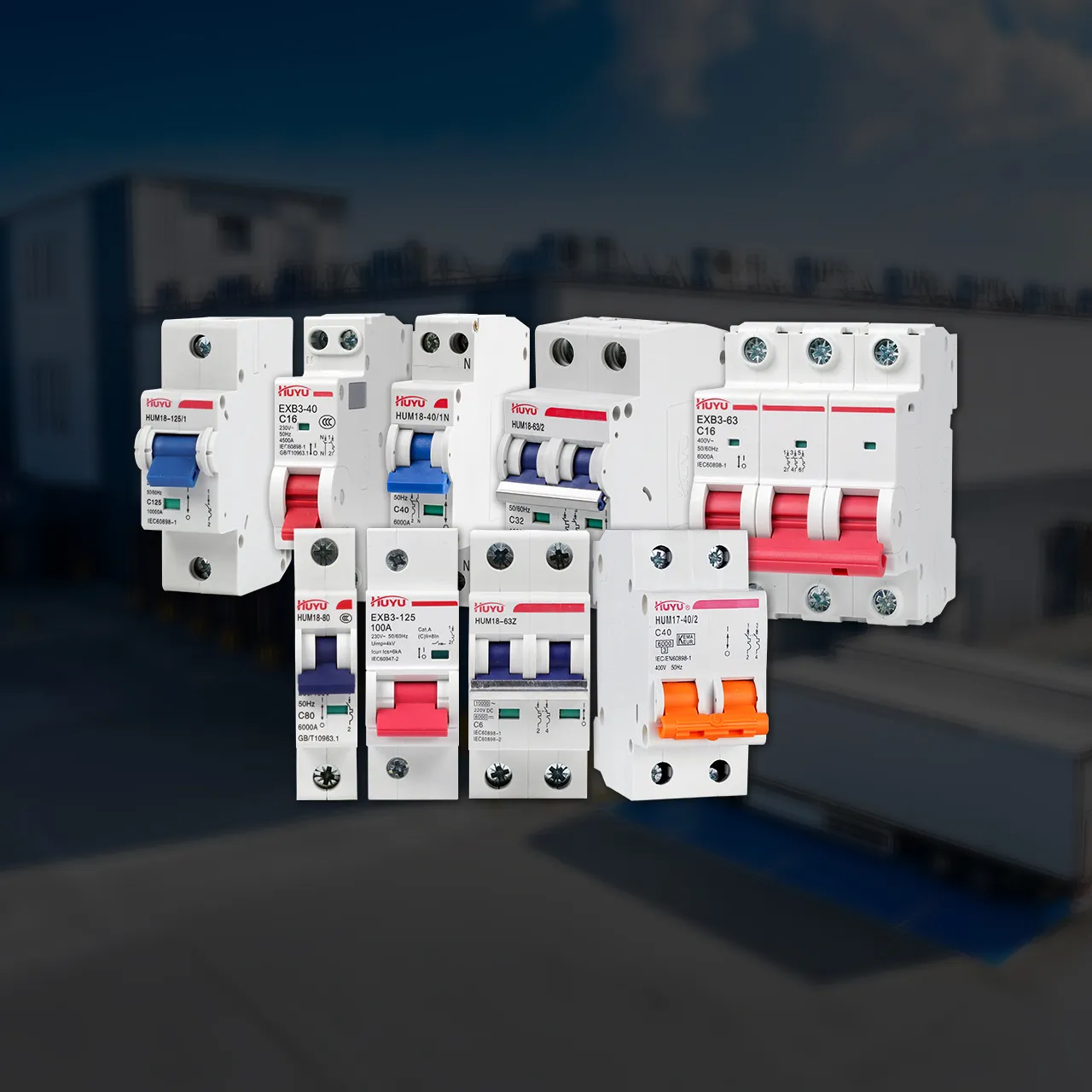
Types of Breakers: How Do You Choose the Right One?
Not all circuit breakers are the same. Based on your loads and panel compatibility, you will choose the correct type of circuit breaker for your application.
Standard Circuit Breakers
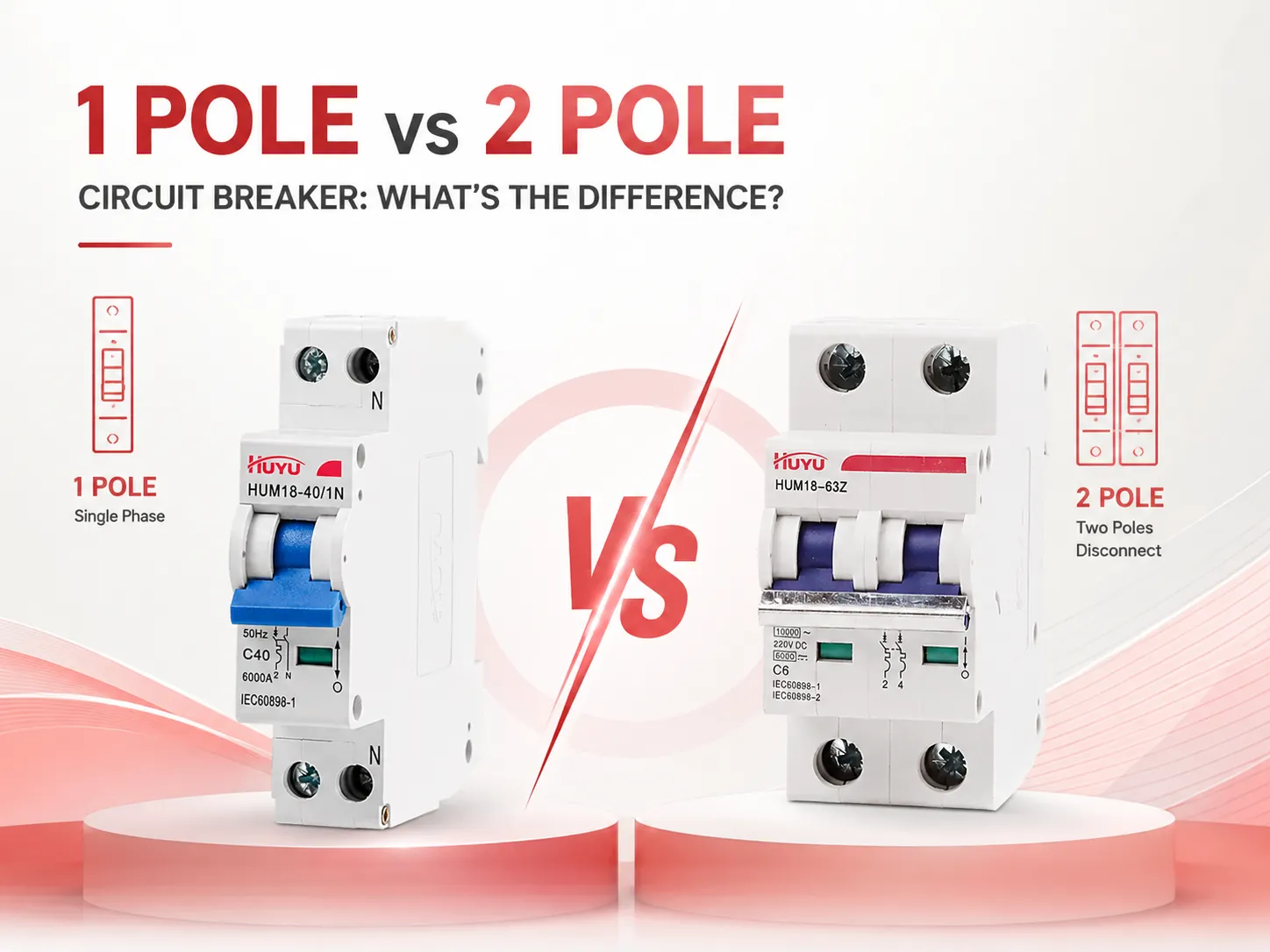
Also known as single-pole breakers, standard circuit breakers are designed for use with 120-volt circuits and are by far the most common type of breaker in a residential panel. They are used to protect common loads such as lights, receptacles, and small appliances.
Sizes: 15A, 20A, 30A
Cost: $5–$20
Double-Pole Circuit Breakers
Double-pole breakers are designed to protect 240-volt circuits that are used for larger appliances like electric ranges, water heaters, and air conditioners. Double-pole breakers take up two slots in your panel and carry double the amount of current as a single-pole breaker.
Sizes: 30A, 40A, 50A, 60A, 70A, 80A
Cost: $10–$30
Ground Fault Circuit Interrupter (GFCI) Circuit Breakers
Ground Fault Circuit Interrupter (GFCI) circuit breakers are used to protect individuals from electric shock in wet areas. Typical locations for GFCI circuit breakers include kitchens, bathrooms, and outdoors. GFCI circuit breakers will trip when a current imbalance occurs between the hot and neutral wires.
Sizes: 15A & 20A (single-pole), 30A & 40A (double-pole)
Cost: $20–$50
Arc Fault Circuit Interrupter (AFCI) Circuit Breakers
Arc Fault Circuit Interrupter (AFCI) circuit breakers are designed to prevent fires that are caused by electrical arcing. Circuit breakers are necessary to have for new construction projects in bedrooms, living rooms, and other areas of a dwelling.
Sizes: 15A, 20A (single-pole)
Cost: $25–$60
Specialty Breakers
Solar Inverter Breakers: Designed for solar panel systems with DC ratings up to 100A for associated DC circuits.
Motor Circuit Breakers: Protect motors from overloads and short circuits and provide adjustable trip settings.
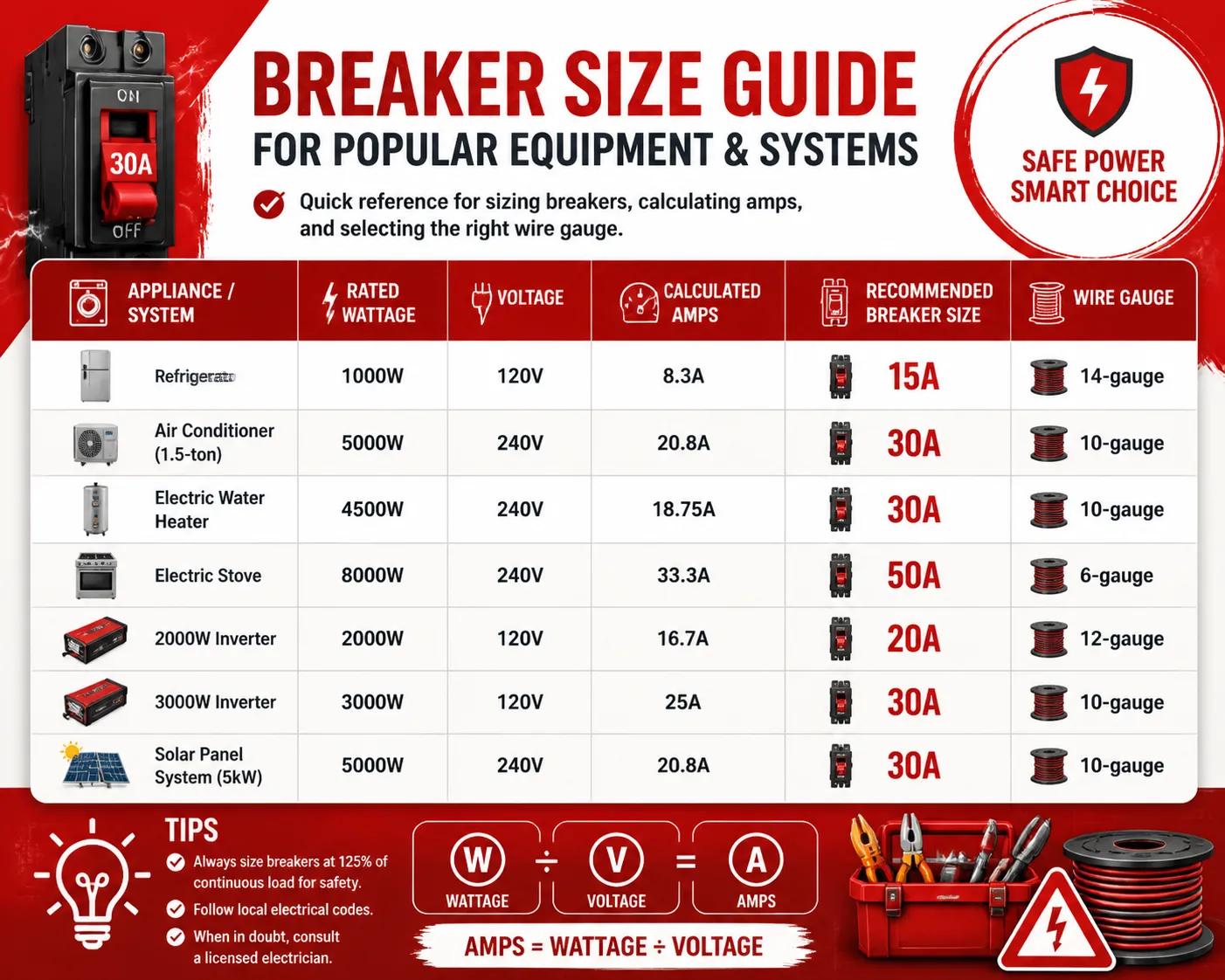
Size Guide for Breakers on Popular Equipment and Systems
Here’s a quick reference for sizing breakers when connecting common appliances and systems:
| Appliance/System | Rated Wattage | Voltage | Calculated Amps | Recommended Breaker Size | Wire Gauge |
|---|---|---|---|---|---|
| Refrigerator | 1000W | 120V | 8.3A | 15A | 14-gauge |
| Air Conditioner (1.5-ton) | 5000W | 240V | 20.8A | 30A | 10-gauge |
| Electric Water Heater | 4500W | 240V | 18.75A | 30A | 10-gauge |
| Electric Stove | 8000W | 240V | 33.3A | 50A | 6-gauge |
| 2000W Inverter | 2000W | 120V | 16.7A | 20A | 12-gauge |
| 3000W Inverter | 3000W | 120V | 25A | 30A | 10-gauge |
| Solar Panel System (5kW) | 5000W | 240V | 20.8A | 30A | 10-gauge |
Installation & Maintenance Tips for Circuit Breakers
Proper installation and maintenance will keep your circuit breakers working as intended:
Panel Compatibility: Be sure that the circuit breakers you purchase for use with your main power panel are from the same manufacturer (for example: GE circuit breakers should be used in GE panels, and Siemens circuit breakers in Siemens panels) because using a breaker from a different manufacturer than the one for which the panel was manufactured may create the potential to cause tripping or damage to your main power panel.
Do Not Overload Panels: Be sure that your main circuit breaker is sized properly to handle the total electrical load in your home. (A 200-amp main circuit breaker is typically recommended for any new dwelling being built today that will have many different types of appliances and/or electronics located in the home.)
Regularly Test Breakers: Press the “test” button on any GFCI/AFCI breaker every 3–6 months to ensure that the breakers function as intended by tripping.
Replace Faulty Breakers: If a breaker trips often, feels hot to the touch when checked, or makes a buzzing noise, then it has failed and needs to be replaced. You should not replace the breaker with a larger rating or you may overheat the wiring.
FAQ: Common Questions About Circuit Breakers
Should a house have 100 amp or 200 amp service?
A 200-amp service is recommended for modern homes with multiple large appliances (electric stoves, water heaters, air conditioners), solar panels, or electric vehicle chargers. A 100-amp service may be sufficient for smaller homes with fewer appliances, but it can become overloaded if you add new equipment.
Can I run a 30 amp dryer on a 40 amp breaker?
Yes, but you must use 10-gauge wire rated for 30 amps. The 40-amp breaker provides extra capacity, but the wire size must match the dryer’s 30-amp rating to prevent overheating. However, it’s best to use a 30-amp breaker for a 30-amp load to comply with the 80% rule.
What breakers work in a GE panel?
GE panels are compatible with GE-branded breakers, including Q-line, THQL, and HQ series breakers. Some third-party breakers (e.g., Square D Homeline) may work, but GE recommends using their own breakers for safety and compatibility.
Can you run a 50 amp breaker on a 100 amp panel?
Yes, as long as the total load on the panel doesn’t exceed 100 amps. Calculate your home’s total wattage and ensure the sum of all breakers doesn’t exceed the panel’s rating (though it’s normal for breakers to add up to more than the panel rating, as not all loads run at once).
What size breaker do I need for a 240 volt outlet?
The breaker size depends on the outlet’s rating. A 240V outlet for an electric dryer uses a 30-amp breaker, while an outlet for an electric stove uses a 50-amp breaker. Match the breaker size to the outlet’s amp rating.
Selecting the right size circuit breaker is a critical step in any electrical installation, whether you’re upgrading your home’s service or adding a new appliance. By calculating your load’s amperage, applying the 80% rule, and choosing the right breaker type (GFCI, AFCI, double-pole), you ensure your electrical system stays safe and efficient. For specific appliances like air conditioners, solar inverters, or electric stoves, refer to our sizing guide to match the breaker to the load’s requirements. Always work with a licensed electrician if you’re unsure about breaker sizing or installation, and remember to test your breakers regularly to prevent fires and equipment damage. With the right breaker, you can power your home or business with confidence.