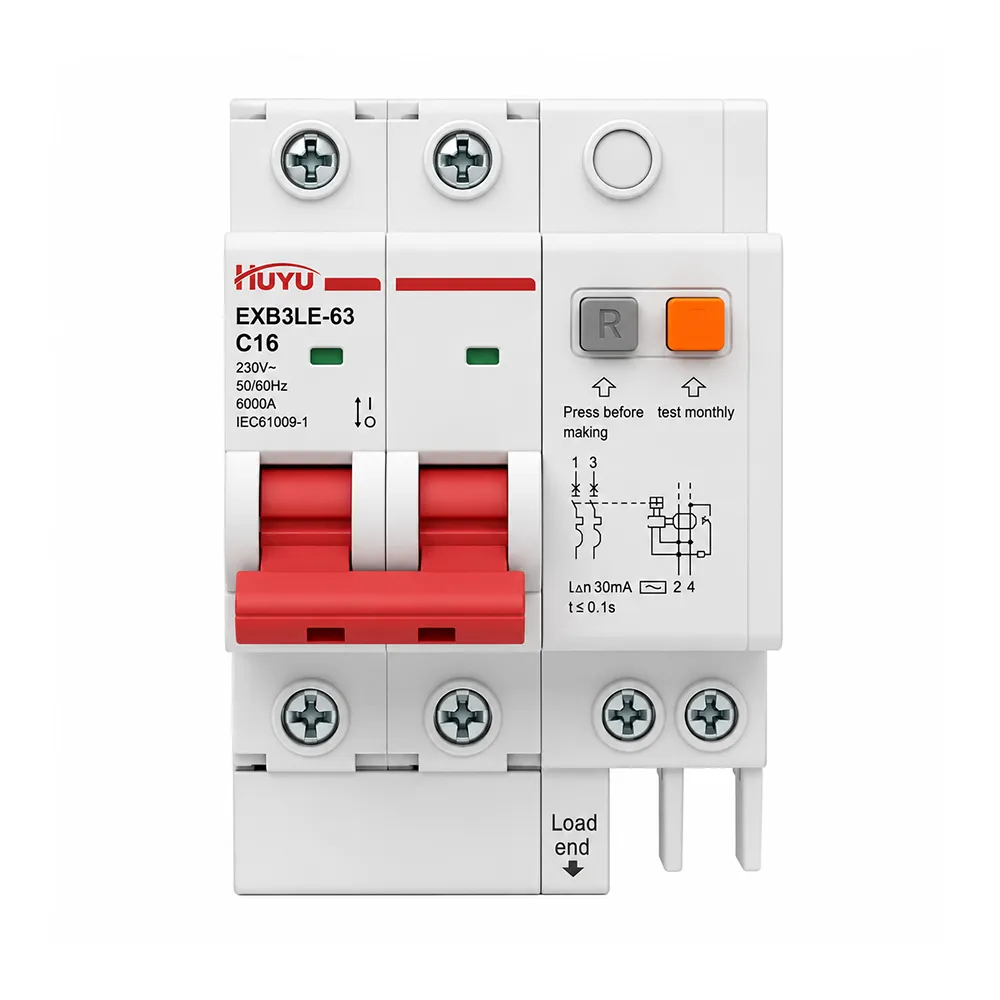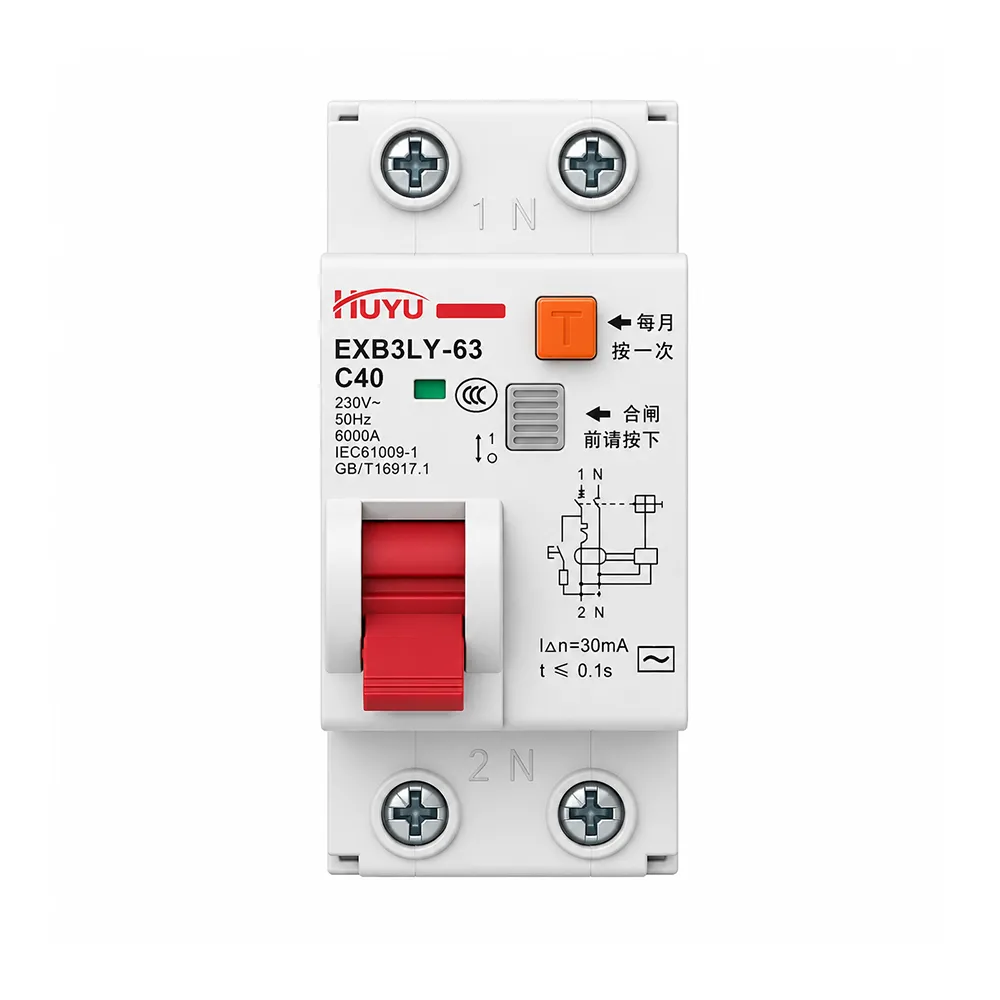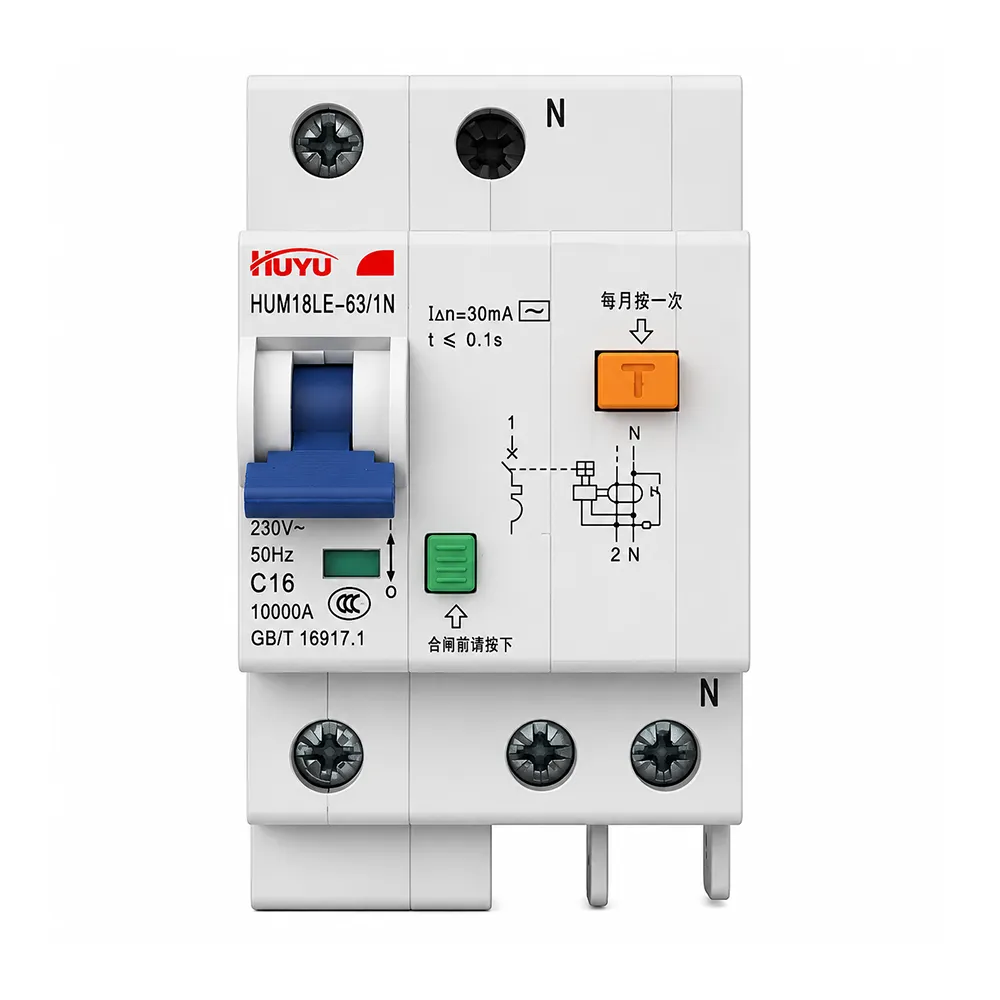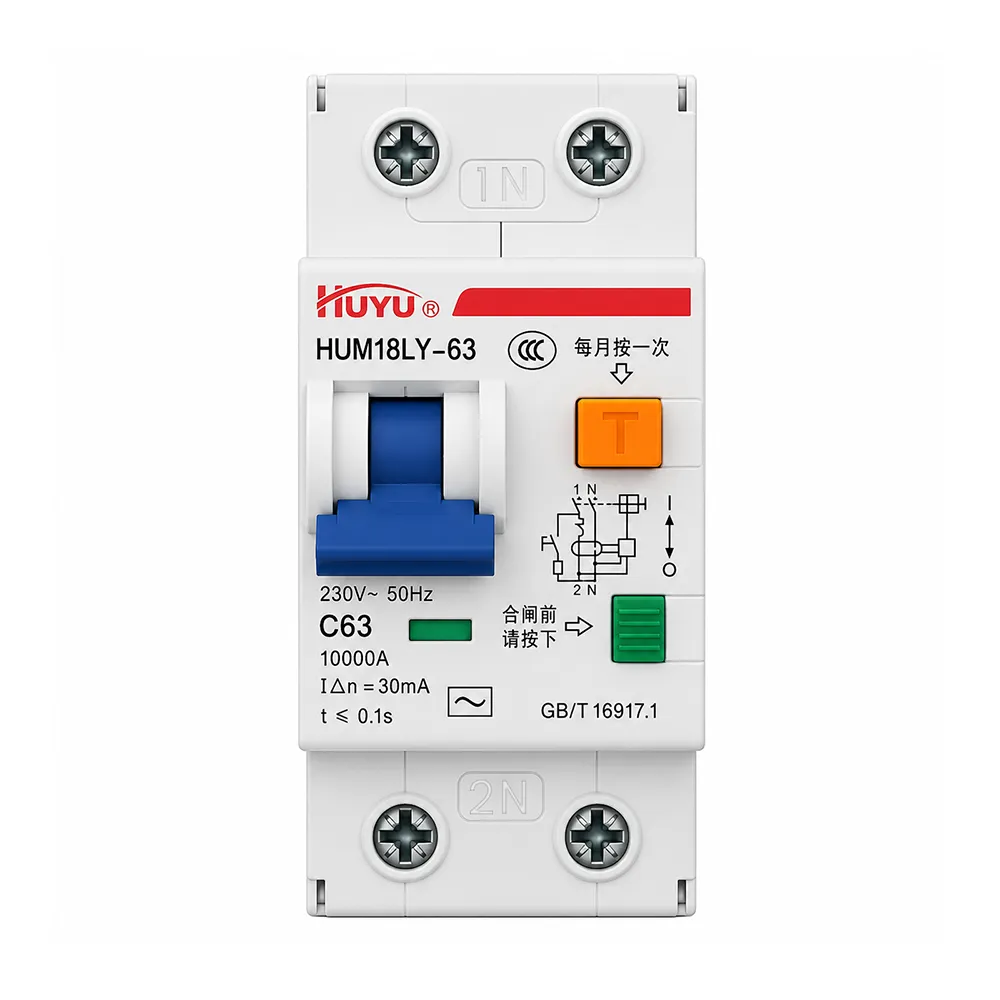

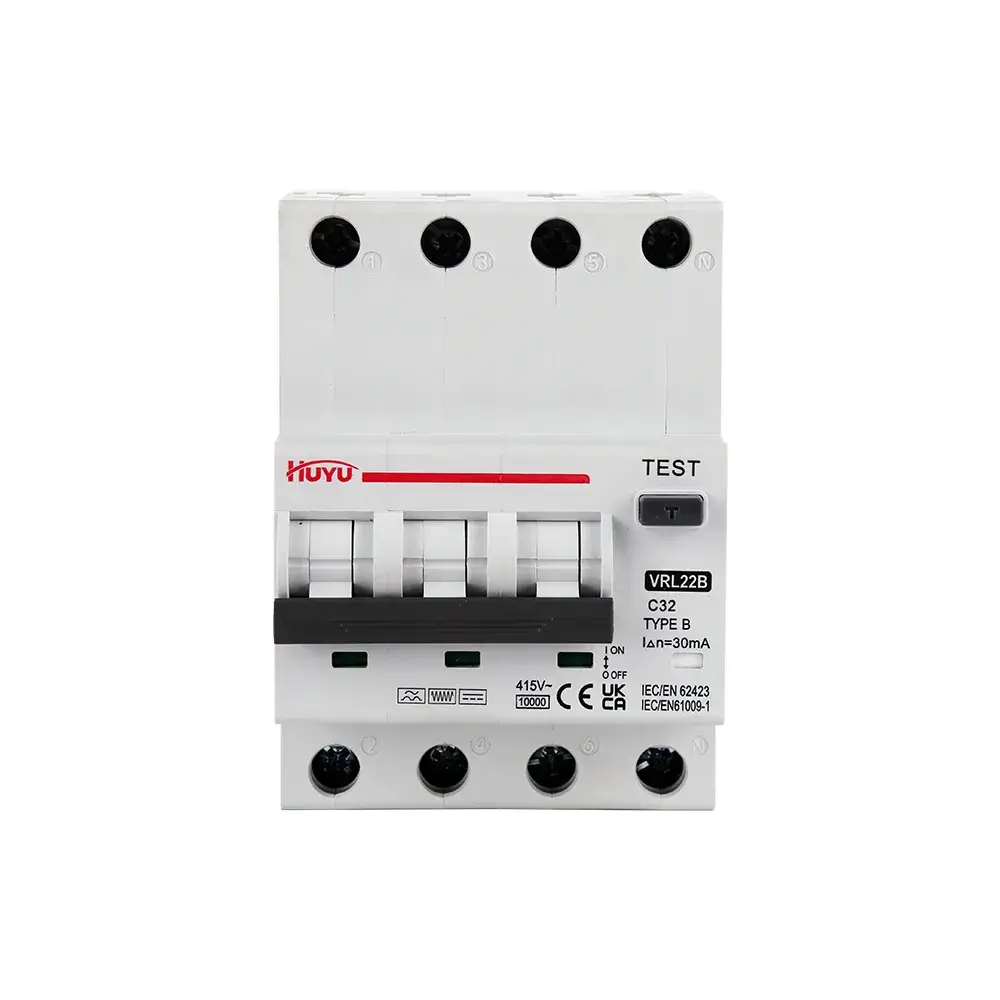
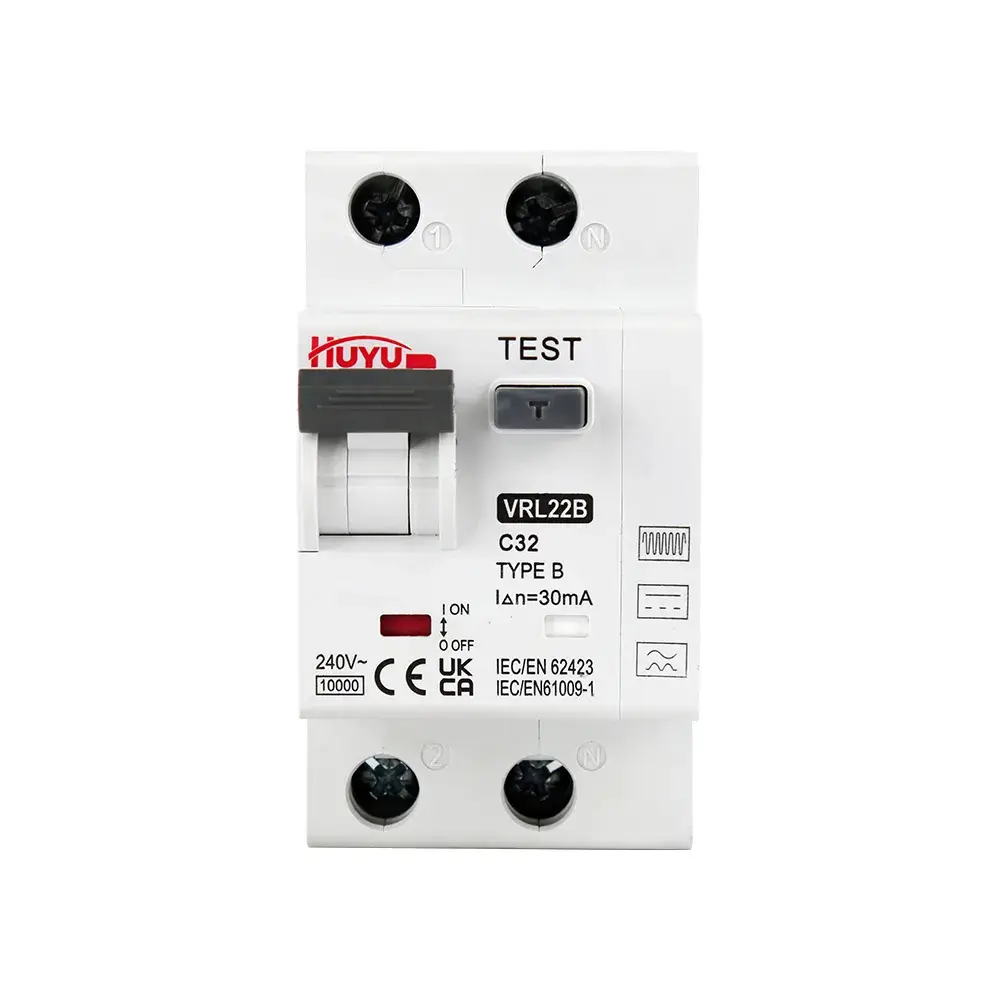
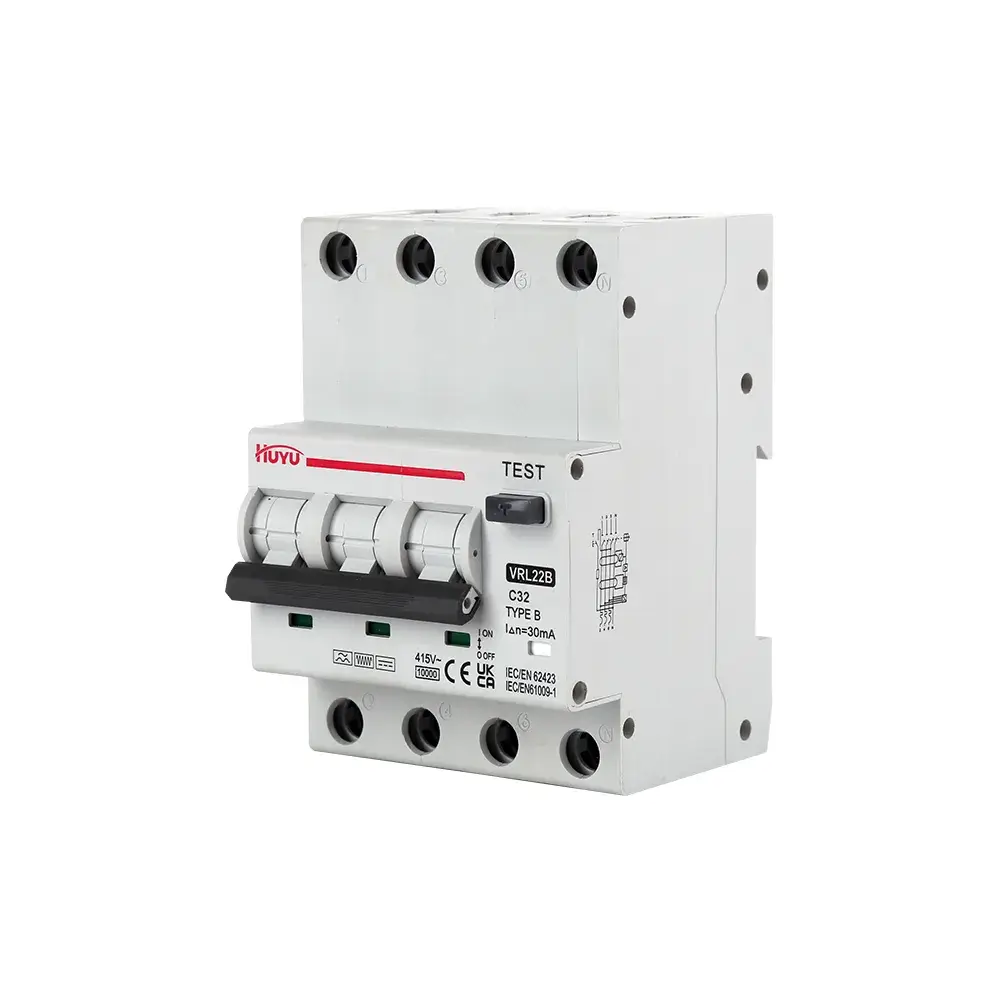
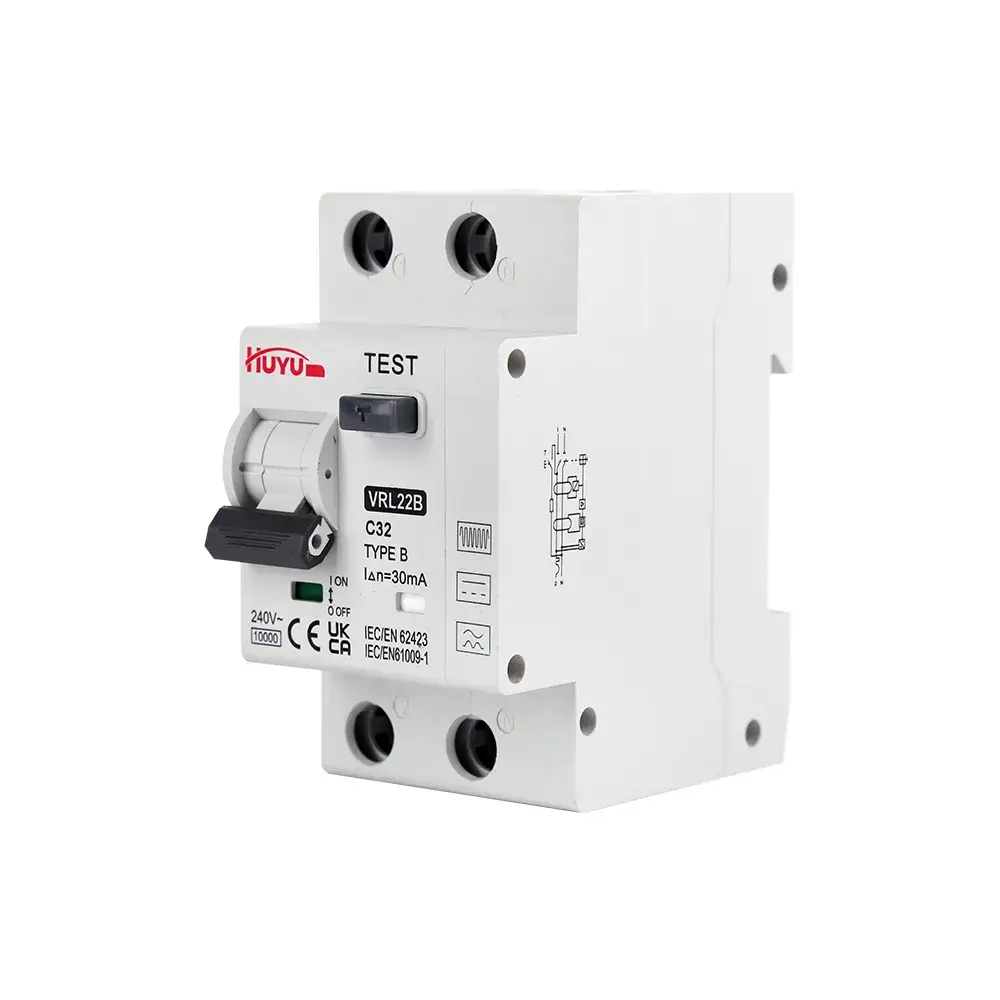
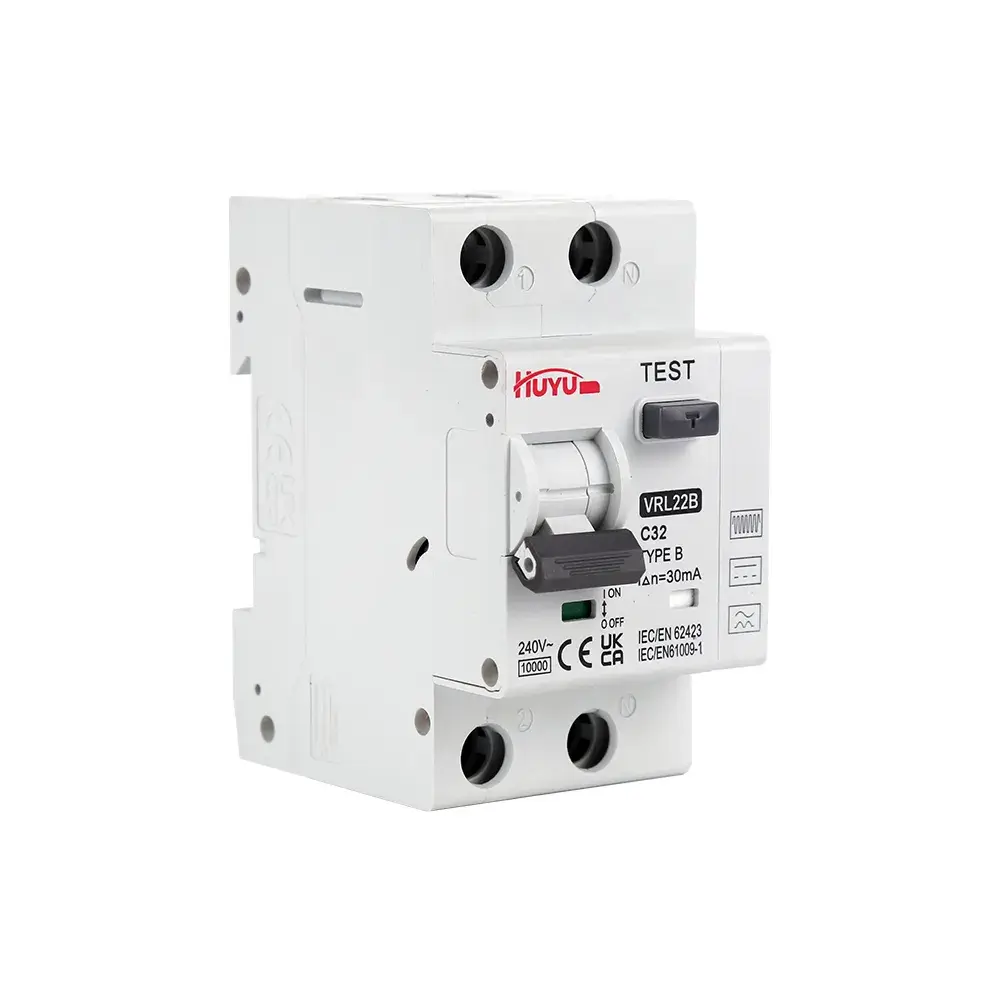
VRL22B – Type B RCBO Breaker 6A-63A 30mA
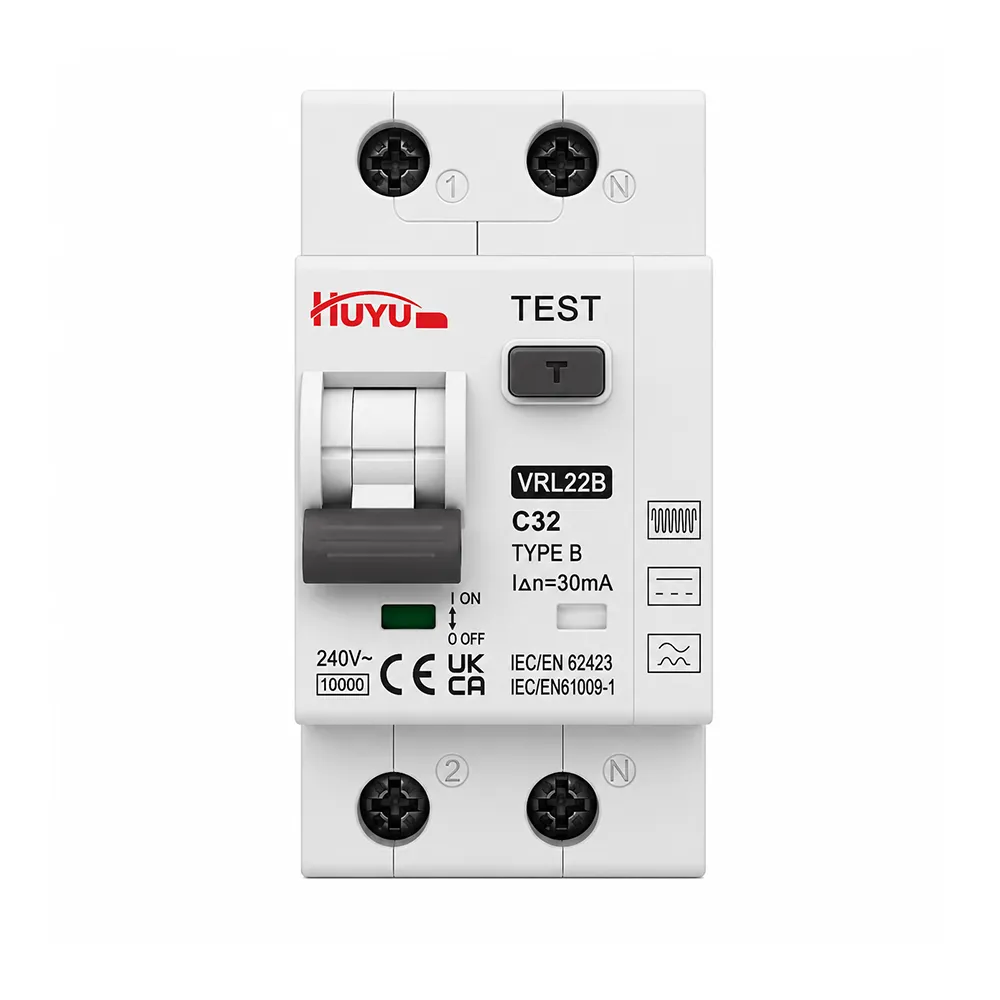
The VRL22B is a Type B RCBO rated 6A–63A at AC 230/400V. Detects AC, pulsating DC, and smooth DC residual currents. 30mA to 500mA sensitivity. 2P/4P. 6kA/10kA Icn. Frequency response up to 1kHz (B) / 20kHz (B+). For EV chargers, VFDs, and PV inverters. IEC 62423 certified.
Standard: IEC/EN 62423, IEC/EN 61009-1, OVE E8601
Rated Current: 6A – 63A
Poles: 2P (single-phase), 4P (three-phase)
Residual Current Type: B / B+ (AC, A, B)
Sensitivity: 30, 100, 300, 500mA
Breaking Capacity: 6kA / 10kA
Applications: EV charging, variable frequency drives, PV inverters, industrial controls
Product Information
VRL22B Type B RCBO Breaker is Designed for Complete Protection of Current-Intensive DC Applications
VRL22B by HUYU Electric is the only BC (Breaker Class) with the ability/capacity to detect faults in circuits that would normally go undetected by AC RCD’s (Residual Current Devices). Examples: EV Charging Systems; VFDs (Variable Frequency Drive); PV Inverter; Industrial Power Supplies, which produce Smooth Direct Current Stable and Maintain Voltage Constant at All Times, are sources of Smooth Direct Current to Circuit of RCD’s Types A and AC are unable to detect, and therefore provide no protection from Electric Shock and Fire Hazards.
The VRL22B RCBO Series comes in two current ranges: 6A to 50A and 63A. The entire product will comply with the latest IEC/EN standards, OVE, VDE, and UL.
For use in commercial and industrial applications with different types of transformers, induction motors, capacitors, and devices with short-circuit current ratings (SCCR), the VRL22B Series RCBO from HUYU Group is available with standard and oversized bushing configurations.
Technical Specifications
| Parameter | VRL22B / VRL22B+ |
|---|---|
| Standards | IEC/EN 62423, IEC/EN 61009-1, OVE E8601, VDE 0664-400 |
| RCCB Type | Type B / Type B+ (AC, pulsating DC, smooth DC) |
| Number of Poles | 2P (single-phase), 4P (three-phase) |
| Rated Current In | 6, 10, 13, 15, 16, 20, 25, 32, 40, 50, 63A |
| Rated Voltage Ue | 2P: AC 230/240V; 4P: AC 400/415V |
| Tripping Curve | B (3-5In), C (5-10In), D (10-20In) |
| Rated Residual Current IΔn | 30, 100, 300, 500mA |
| Breaking Capacity Icn | 6,000A / 10,000A (Energy limiting class 3) |
| Tripping Mode | Instantaneous, Short-time delayed (G/ASI), Selective (S) |
| Frequency Response | Type B: Up to 1kHz; Type B+: Up to 20kHz (Tripping <420mA) |
| Insulation/Impulse Voltage | Ui: 500V; Uimp: 4kV (1.2/50µs) |
| Endurance | 25,000 cycles (Mechanical & Electrical) |
| Terminal Capacity / Torque | 1–25mm² / 2–2.5 Nm |
| Ambient Temperature | Operating: -25°C to +55°C; Storage: -40°C to +70°C |
| Protection Degree | IP20 |
| MOQ | Contact for project quotation |
Why Type B Residual Current Protection Matters
Electric vehicle (EV) chargers, three-phase inverters, and variable frequency drives (VFDs) are examples of devices that have rectifiers and/or switching semiconductors and therefore can produce pure DC residual currents in the event of a fault. If a Type A RCBO does not trip on smooth DC residual current, the circuit will be unprotected. The Type B VRL22B RCD (part of an RCBO) has been tested for its ability to detect and initiate tripping operation in the presence of DC residual currents. This assures the safety of personnel in advanced power electronic environments. The primary purpose of the selectable tripping modes (instantaneous, short-time delay, and selective) is to allow the cascading of the device with downstream devices, providing added flexibility in the choice of RCBOs for inverters and many types of industrial applications.
Request a Quotation for VRL22B Type B RCBOs – Factory Direct
6A–63A, 30–500mA, Type B/B+. 2P/4P, 6kA/10kA. IEC 62423 certified. For EV chargers, VFDs, PV inverters. OEM/ODM with private labeling and full documentation. Contact us for pricing and lead time.
Project-Based Quotation • IEC 62423 • Worldwide Shipping
OEM/ODM Supply – Type B RCBOs for Next-Generation Electrical Systems
VRL22B – The Type B RCBO Designed for the Electrification Era
With the rapid growth of EV adoption and renewable energy, demand for Type B RCBOs has surged. Major manufacturers such as Hager, Schneider Electric (Acti9), ABB, and Eaton offer Type B RCDs and RCBOs, but supply can be constrained. HUYU Electric’s VRL22B series provides an equivalent, fully certified alternative with the flexibility of OEM branding. Available in 30mA for personal protection, 100/300mA for fire prevention, and 500mA for industrial coordination, the VRL22B covers all standard requirements. Factory-direct OEM/ODM includes custom silk-screening, private-label packaging, and complete IEC 62423 type-test documentation to support your project approvals.
How to Choose a Type B RCBO for EV and Industrial Applications
Key selection criteria for the VRL22B in circuits with DC residual current.
1. Type B vs. Type B+: When Higher Frequency Matters
Select the standard Type B RCBO for most EV charger and PV inverter applications where the switching frequency is below 1kHz. Choose the Type B+ variant when the circuit includes high-frequency power converters with switching frequencies up to 20kHz. The B+ ensures reliable detection of leakage currents at these higher frequencies, preventing nuisance tripping or failure to trip.
2. Sensitivity Selection for Different Risk Levels
Use 30mA for personnel protection in accessible circuits, such as domestic EV chargers and residential PV inverters. Select 100mA or 300mA for fire prevention in sub-main distribution where cable lengths may produce higher natural leakage. Use 500mA for coordination with downstream devices in industrial installations. The VRL22B offers all four sensitivity options.
3. Tripping Curve and Inrush Considerations
Choose the B curve for purely resistive loads. The C curve handles the moderate inrush of EV chargers and most electronic equipment. Use the D curve for circuits with high inrush, such as large transformers or direct-on-line motor starting. The VRL22B’s three curve options ensure correct coordination with the load.
4. Coordination with Other Protection Devices
The VRL22B’s selectable tripping modes — instantaneous, short-time delayed (G/ASI), and selective (S) — allow proper cascading with downstream and upstream protective devices. For circuits with multiple levels of protection, the selective mode prevents the upstream device from tripping on a downstream fault, limiting disruption to the affected circuit only.

Frequently Asked Questions
What is RCBO type B?
An RCBO type B is a residual current circuit breaker with overcurrent protection that is specifically designed to detect and trip on all types of residual currents: AC, pulsating DC, and pure (smooth) DC. This is essential for modern electrical loads such as EV chargers, photovoltaic inverters, and variable frequency drives, which can generate DC leakage currents that a standard Type A or Type AC RCBO cannot detect. The VRL22B Type B RCBO breaker complies with IEC 62423, ensuring reliable protection in these applications.
What is the difference between Type A and Type B RCBO?
A Type A RCBO is designed to detect AC and pulsating DC residual currents (up to 6mA smooth DC may not cause tripping). A Type B RCBO, such as the VRL22B, goes further by also detecting pure DC residual currents. This makes the Type B RCBO mandatory in circuits where a failure in the power electronics could produce smooth DC leakage — for example, in an EV charger where the onboard rectifier fails, or in a PV inverter during an isolation fault. Using a Type A device in these scenarios could result in the RCD failing to trip, leaving the circuit unprotected.
What is the difference between Type A and Type B RCDs?
The difference between a Type A RCD and a Type B RCD mirrors that of RCBOs: a Type A RCD detects only AC and pulsating DC, while a Type B RCD adds detection of smooth DC residual currents. The VRL22B is a Type B RCBO, meaning it combines the residual current detection of a Type B RCD with overcurrent protection in a single device. For circuits requiring only residual current protection without overcurrent, a standalone Type B RCD could be used, but for integrated protection, a Type B RCBO saves space and simplifies wiring.
Can you use type B RCBO in domestic?
Yes, a Type B RCBO can be used in domestic installations, and in some cases it is required. For example, in the UK, wiring regulations (BS 7671) now mandate Type B RCD protection for domestic EV chargers due to the potential for DC leakage. Even outside of EV charging, if a domestic installation includes a PV inverter or a heat pump with a variable speed drive, a Type B RCBO may be recommended by the equipment manufacturer to ensure proper protection. The VRL22B Type B RCBO, available in 30mA sensitivity and 2-pole configuration, is suitable for these domestic applications.
No documents available for download at this moment.